You may be wondering why we are discussing the origin of men when we set out to talk about the Word's becoming Man. The former subject is relevant to the latter for this reason: it was our sorry case that caused the Word to come down, our transgression that called out His love for us, so that He made haste to help us and to appear among us.
It is we who were the cause of His taking human form, and for our salvation that in His great love He was both born and manifested in a human body. For God had made man thus (that is, as an embodied spirit), and had willed that he should remain in incorruption. But men, having turned from the contemplation of God to evil of their own devising, had come inevitably under the law of death. Instead of remaining in the state in which God had created them, they were in process of becoming corrupted entirely, and death had them completely under its dominion.
For the transgression of the commandment was making them turn back again according to their nature; and as they had at the beginning come into being out of non-existence, so were they now on the way to returning, through corruption, to non-existence again.
The presence and love of the Word had called them into being; inevitably, therefore when they lost the knowledge of God, they lost existence with it; for it is God alone Who exists--evil is non-being, the negation and antithesis of good.
...The Word perceived that corruption could not be got rid of otherwise than through death; yet He Himself, as the Word, being immortal and the Father's Son, was such as could not die. For this reason, therefore, He assumed a body capable of death, in order that it, through belonging to the Word Who is above all, might become in dying a sufficient exchange for all, and, itself remaining incorruptible through His indwelling, might thereafter put an end to corruption for all others as well, by the grace of the resurrection.
Showing posts with label Athanasius. Show all posts
Showing posts with label Athanasius. Show all posts
Tuesday, 30 November 2010

Tuesday, 19 October 2010
The Blog Post That Launched a Thousand Blog Posts
I've noticed that some theological errors are very much born out of the specific milieu in which they fester. There are former baptists who become Reformed and become enamoured of Federal Vision or Arminians who go all out in Open Theism. They're pretty specific to their respective groups, and those groups spend a lot of time battling their own flavour of heresy. But sometimes errors come along that are wide-reaching and amorphous enough to touch many people and denominations in many ways.
One I'm seeing crop up from several different angles is something I've dubbed Kenotic Arianism. Kenotic because it has to do with the nature of Christ's lowering himself in the incarnation, and Arian because it ultimately strips him of his divinity at some point, even while it paradoxically struggles to affirm that he is God.
Because some people keep bothering me, I'm going to try to trace this trend and hopefully refute it (and maybe Don Carson will pick up the torch and edit a massive tome on it with a German subtitle). The doctrine has many implications, and the antecedents in known kenotic theology are proving a fascinating maze. It branches out all over the place really, especially given the diversity of positions amongst those who hold to some variation of it. And I'm a terrible intuitive and non-linear thinker. But to get the theo boys off my back, I'm providing a brief(ish) overview here, with the possibility of fleshing it out later.
From what I'm seeing, Kenotic Arianism starts out as an anthropological error that leads to graver theological problems. That is, in most forms I'm familiar with, it begins with a mistaken notion of what it means to be human.
Rey asked once "is the statement 'to err is human' an ontological one?" That is, are errors an essential part of our created nature as humans, or are they an acquired characteristic? I think the question is apropos-it's one the kenotic Arian will ultimately answer "yes" to in one way or another. And from this springs many of his problems. He, in typical idolatrous human fashion, looks at himself in order to see God. But it's done in a very different manner than the idolator might. He will say he looks at himself to describe the human nature of Christ. The logic is, "I am human, and Christ was made in the likeness of sinful flesh, so what I am as a human must be what Christ also took on in the incarnation." That only makes sense doesn't it? Surely Christ was one of us-that's scriptural. But the conclusion is bass-ackwards. It also fails to take into account the effects of the fall on the human race-which has left us irreparably damaged and something less than fully human. Several church fathers (especially my favorite, Athanasius) refer to the effects of the fall as "corruption," and I think this is the most useful term for us to keep in mind.
Corruption suggests a deterioration of soundness, particularly through a destructive or contaminating influence. It is especially used for those falling from a high position as those made in the image of God must be. Sin entered, and I died. The Torah concept of "uncleanness" is in essence, a temporal picture of corruption. We were made for communion with God, as branches receiving life from the vine. At the fall, the branch was chopped off of the vine and began to die. Now, the branch, humanity, displays the effects and stench of slow decay. We are now something less than human. We are contaminated. We are corrupt.
Christ on the other hand was and is not corrupt in any way. He is fully man-more fully man in fact than any of us have ever been. I would say the Kenotic Arian emphasizes the man part of that phrase (even as they insist marks of corruption are what make us fully human); I would however emphasize fully. There is no deterioration or contamination in the humanity of Christ. This is why he is in the likeness of sinful man, but is not himself a sinful man. This is why he as the high priest does not make atonement for himself. Part of our redemption is the restoration of our full humanity via union with Christ-a grafting back in to the life-giving vine.
But if Christ is truly human in a way we know nothing about, looking at ourselves to determine what Christ must be like as a human is like looking at a dead body and wondering why living people aren't so blue and stiff and smelly. Can they really be human if they're not blue, stiff and smelly? Does being pink and active mean one is super-human?
I will say in the KA's favour that many of them seem to want to avoid docetism (the super-human argument in essence). I'm no fan of it myself. But the KA swings hard the other way in emphasizing the humanity of Christ-and unfortunately it's this flawed view of humanity they emphasize rather than his actual perfect humanity.
KAs also usually affirm that Christ didn't sin-they understand that to say otherwise is incorrect. But then that is turned on its head when they say he did show evidence of corruption by becoming unclean or affirming falsehoods, because they see elements of corruption as an integral part of the human person rather than what it really is: a result of the fall. If this is so, then a de facto sinning Christ enters in from the back door.
Here is where we would cite sin as a result of corruption (note sin is not the same thing as corruption). Sin is the natural end state for the corrupted, and in one sense I think it could be argued that when the KA denies Christ sinned, it is he who makes him into a super-powered man because he is capable of doing something no other man can do-act against nature. As an analogy: if you have unsterile conditions in a surgery, infection and then illness are the inevitable results. That's easily understood. But the KA reverses the logic of this understanding and in essence argues Christ was unsterile and infected (corruption) but never actually presented the signs of the illness (sin). This seems incredible.
More incredible yet is that scripture actually presents Christ as something of a "sterilizing agent". When he touched the unclean, they were cleansed. But that then leaves no room for corruption at all. How can bleach harbour the bacteria it kills? How can Christ harbour the decay that he kills?
So what corruption? There are all kinds of ways it plays out in our minds. Did Christ really share all of my experiences or risk losing his humanity? Perhaps Christ didn't know this or that because I don't. Yet in terms of his knowledge of his Godhood, Christ is never portrayed as anything other than fully aware of it (and even as a human being he knew what was in a man). We all make errors in judgement, yet Christ is presented to us as the one who always makes right judgements. The unclean could not be part of the assembly, But Christ was always in communion with the Father. In terms of error, uncleanness, sickness and so on, these apply to us because of our corruption not because of our humanity-we can see this in how he, as God, destroyed uncleanness, sickness and ultimately death.
That error is, as stated, basically anthropological. It first mistakes what humanity really is or should be, and then secondly applies that to Christ as human (usually to avoid docetism as mentioned). Whatever form it takes, as soon as the error is applied to him, troublesome theological implications arise. Besides making Christ ironically less human rather than more (as we are repainting him corrupt as we ourselves are) Christ is suddenly also less God. In order for him to become this more "real" human, the KA strips away many divine attributes from Christ and replaces them with contradictory human aspects that exist because of our corrupt and Godless state. Aspects that are at odds with the character of God. So none of these would or can apply to him, and are not applied by scripture but by human speculation.
Some do this in a self conscious manner that is ultimately Nestorian. Generally the "kenosis" passage of Phillipians 2 is cited. This, it is argued, shows that Christ divested himself of his divinity in the incarnation. It's almost as if his divinity was a nicely pressed suit that he didn't want to get dirty, so he left it hanging in the closet of heaven. But it leaves us with a Christ who during his incarnation on this earth, was essentially not God. It is the only way that the application of error or ruined dna or uncleanness can be applied to Christ. These things can not be applied to God surely. But then Christ loses his divinity for the scheme to work. An essentially Arian scheme is created, even if unwittingly. All because of a mistaken notion of what it means to be human.
This is, of course, only the tip of the iceberg and various parts of Scriptures--specifically Hebrews--would address it. Because it is such a maze, that's going to take some heavy duty posts from people better than me (ie Don Carson) and not in battleaxe school. But since rey and mem are bleating piteously and incessantly about it like my cat used to do directly outside my window when I threw him outside because he had worms (and probably looking all sad and big eyed too), I am posting what I've got if only to stop the whinging.
Now, what is The Don's email??
Monday, 29 March 2010
B Team
As you all know, I enjoy history of theology. Usually when we study the history of faith we like to emphasize the stalwart heroes. Those are good and inspiring stories after all. We all know how much Athanasius suffered and how brilliantly he fought both the Arians and the progressive Originians (at least you should if you've ever read this blog). Luther was a lighting rod with the strength to withstand the charge that began the reformation that was years in the making.
Yet we know that for every Athanasius there's a Liberius and for every Luther there's a Melanchthon. The ones who fell down a few times. Hard. I find that people with no experience of such pressure and a Donatist streak in their hearts like to reach through the ages to push them down all over again. Yet in many ways, they exemplify the struggles of the faithful better than their stronger contemporaries. Not everyone has the strength to stand contra mundum. Not everyone is meant to. We repeat the story of Peter's betrayal, understanding he was forgiven, but often do not extend the same to those who followed after him.
So I love Athanasius and Luther, but I understand Liberius and Melanchthon. And I think if most of us were honest with ourselves we would. We aren't Athanasiuses (as much as we would like to pretend we are while arguing with losers on the internet). We don't have his brilliance or his foresight or his ability to know which battles to pick and how to pick them. Most of us are b team with the other rejects.
Liberius had both the weight of exile and of his flock back at home on his shoulders. In the end it proved too hard to be separated from them all. His lapse was certainly a disappointment and it seems he tried hard to forget it. He capsized in humiliation and weakness.
I have often thought Philipp Melanchthon was a man in some ways out of his own time, faulted for lacking conviction and being too conciliatory (today he'd probably be commended for his irenicism). He seemed so unsuited to the role foistered on to him-the scholar now following around in Luther's wake like a clean up crew of one, apologizing for all the destruction. He tried hard to build bridges--but too often those bridges led to nowhere and he wavered and foundered in trying to build them. While he did show weakness of conviction, he struggled to do what he thought was best. It turned out it wasn't.
As much as I'd like to hang with Athanasius, this sounds like my team.
In the end I think we need to give the less than heroic brothers a break. They have much to teach us. If the Christian life really is one of repentance as Melanchthon's great friend said, it requires some ugly and abject defeats. But our failures could not give up on the faithfulness of God even when they had to give up on themselves as sunken wrecks and disappointments. They, not the heroes, are the ones who remind us of the faithfulness of God in Christ to the faithless, to the broken. When one is sinking in the sea, one can only reach out in one direction. In weakness, they can only point to him.
Friday, 30 October 2009
The Glory of Christ
that real view which we may have of Christ and his glory in this world by faith,--however weak and obscure that knowledge which we may attain of them by divine revelation,—is inexpressibly to be preferred above all other wisdom, understanding, or knowledge whatever...
The revelation made of Christ in the blessed Gospel is far more excellent, more glorious, and more filled with rays of divine wisdom and goodness, than the whole creation and the just comprehension of it, if attainable, can contain or afford. Without the knowledge hereof, the mind of man, however priding itself in other inventions and discoveries, is wrapped up in darkness and confusion.
John Owen, The Glory of Christ, preface to the reader.
As he lay dying, Owen was notified of the pending publication of this work. To this he replied that he had finally arrived at the long awaited day when he would see that glory in a way that he had never seen or could even imagine seeing in this world. He was ready to finally see the glory of Christ, truly as it is, with no glass, no veil. One can't help but think he was ready even as he wrote the words above. Ready to pass from glory to glory, and be transformed.

I am busy with school so I don't have time for much else but I hate the feely paper I have to write for class next week so I am skiving off at the moment. Athanasius is visiting SIAST library for a year (and everyone insists I should declare him finished-he is NOT finished-admittedly he might never be). Some people really gushed over him which was a little embarrassing, and one woman told me she was glad he wasn't white. (Anglicans...) But everyone seemed to recognize his indomitable stare, so that was cool. Hey I conveyed something.
Anyway I started John Owen as a brother for Athanasius over the summer-the noil was as difficult as ever to dye. I did it in logwood, let it soak for weeks, bathed it in iron and back to the logwood. Then I did a wash over it with soliel paint. It's very uneven, but not in a totally bad or unfixable way. That really showed up worse in the picture. I'll fix some of the worst of it later.
This one is a little different just because we know what John Owen basically looked like from contemporary portraits. I am using the John Greenhill portrait of him, which is the most detailed and I think captured his eyes best. I love his eyes in that one. It's also the only portrait including the man's actual hair. But I'm also using a few others for reference so it won't look just like that one-I think it is a tad idealized after all. I sketched it out and am pleased with the sketch. So far the big piece looks okay-I have to make the hook in his nose more apparent and work on the mouth.
As you can also see, while Athanasius is very low contrast, John Owen will be quite high contrast. The white layers have been rather heavy thus far, so I haven't added as many and I have a good imprint. I found a nice slubby black/grey duppioni that would do well for the background-not too shiny. I should probably buy some. I'm not as sure how I am going to work the background yet. John Owen is hard to pin down, but I am working with his work on communion with God by/and the glory of Christ at the moment-hense the name. I have some shadowy ideas on that, but I haven't come up with anything concrete. So I'll just work on the face for now.
With work and school, I don't have so much time to work on this, but I am thinking I will need at least some distraction some time or feely class will make me tear my hair out. So it's there, waiting. And these portraits require a fair bit of drying time and are easy to just pick up and work on a little here and there, so I think it will be ideal.
Friday, 2 May 2008
As Brightness from a Light
We believe in one Unbegotten God, Father Almighty, maker of all things both visible and invisible, that hath His being from Himself. And in one Only-begotten Word, Wisdom, Son, begotten of the Father without beginning and eternally; word not pronounced, nor mental, nor an effluence of the Perfect, nor a dividing of the impassible Essence, nor an issue; but absolutely perfect Son, living and powerful, the true Image of the Father, equal in honour and glory.
...In humanity He was crucified and died for us, and rose from the dead, and was taken up into the heavens, having been created as the beginning of ways for us, when on earth He shewed us light from out of darkness, salvation from error, life from the dead, an entrance to paradise, from which Adam was cast out, and into which he again entered by means of the thief, as the Lord said, ‘This day shalt thou be with Me in paradise’...
Statement of Faith of Athanasius
I hope you take some time to remember our favorite Church Father today peeps. Praise God for preserving his doctrine by means of earthen vessels such as he.
And if that seems like too much, well we could always make an effigy of Eusebius of Nicomedia and burn the crap out of that sucker.
Sunday, 23 March 2008
The Pledge and Token of his Victory
Fitting indeed, then, and wholly consonant was the death on the cross for us; and we can see how reasonable it was, and why it is that the salvation of the world could be accomplished in no other way. Even on the cross He did not hide Himself from sight; rather, He made all creation witness to the presence of its Maker. Then, having once let it be seen that it was truly dead, He did not allow that temple of His body to linger long, but forthwith on the third day raised it up, impassable and incorruptible, the pledge and token of His victory.
On The Incarnation book 5
Tuesday, 12 February 2008
The Golden Decade
Constantine's sons favoured opposite sides in the controversy. The first return was brief for Constantius again deposed Athanasius and after hiding out in the city for awhile he escaped to Rome. In the intervening years the Arians held counsels and wrote their own creeds while the Nicenes countered, many of whom had ended up in exile in the West under the protection of Constans and the Bishop Julius.
At the end of his second exile, Athanasius had been from his people for about seven years and now the Arian bishop who had replaced him was dead. In those years Eusebius also died. Constantius finally offered to reinstate him and Athanasius returned to his beloved flock In Alexandria. The Golden Decade had begun.
Aren't you glad we're to the part of the story where we get rid of Eusebius? Happy turning point there. Ding dong and all that.
It hasn't been seven years but this piece has languished some-though I have regularly been building highlights on it. Particularly given how the test piece worked out, I was afraid of embroidering it as I had originally planned. I still think that would have looked awesome, but I love the piece too much to take many risks with it at this point. I mean I'm sure we can all agree that the test piece looked pretty awful.
Anyway I think that Athanasius would not be impressed to know that fear of ruination would keep me from moving forward, so I decided to abandon the original idea for the embroidery and did running stitches by hand instead. these will be built up in the quilting which I have decided will also be done by hand. The contrast and texture I had intended is simply not there and while I think this does hurt the piece, I can live with this as opposed to an unmitigated disaster of threads.
Perhaps I will expand that coptic theme until I am better at it-companion pieces! Anyway here is how the piece stands. The dupioni has been added and stitches done for the moment.

Because I had chosen to make the halo and the world basically the same size, this meant an unusually small halo, and it is set oddly in the picture because of the shading. That was the thing I played with again and again in the original layout.
I was leary of my original idea of applying gold leaf in a deconstructed manner, but decided to go ahead with it. Now I am regretting that a little...Here is a close-up of the way the halo turned out. I think I can still do some salvaging once paint has dried. I still need to apply the 96th layer of paint to even the intensity out, and some other things.

As mentioned, varying intensities in the paint at the moment are leaving it looking a little wonky, and I have a good amount of work to do on that halo to fix it. But once I decide whether I want to do the edge treatment I had considered then forgotten about then found again, ( I like it but am again leaning against it) I can move on to quilting. Then it's only a few more exiles until finishing.
Sunday, 28 October 2007
You Are the Holy One
 Hallowed Be Thy Name, machine embroidered with metallic threads on silk noil and dupioni.
This has not translated in the scan well at all. I am still debating how I feel about the actual piece, particularly since it was a test piece for Athanasius. I know he has been languishing in his desert exile for almost a year; hanging out with Antony, writing subversive letters and whatnot. As history bore out, those complete losers Eusebius and Constantius couldn't keep him down and he is gearing for a triumphal return. There will probably be some rioting in the near future.
Anyway I am not so proficient with my machine work these days (especially since I am still getting used to teh noo machine), so it's a good thing I tried this out. The metallics of course don't show up the way they should. The gold is the only one you can really see in the scan, however in the actual piece I am thinking it is too distracting. I think I need to keep playing with thread colours. I like the copper and I think I am going to go tonal and eliminate the gold. We'll see.
This is the first CIP piece I've done since we ripped up the back room-yes I am still working on it! I'm still not finished the art room-I have to make the curtains and set up the paper hangers yet. There were other minor things I was intending on, but I am getting tired of it and I think that once those two things are done then so is the room.
My hands smell like oil paint from the paintstiks....since you all think I stink anyway, it doesn't matter.
Thursday, 8 March 2007
You cannot put straight in others what is warped in yourself.
When the madness of idolatry and irreligion filled the world and the knowledge of God was hidden, whose part was it to teach the world about the Father? Man's, would you say? But men cannot run everywhere over the world, nor would their words carry sufficient weight if they did, nor would they be, unaided, a match for the evil spirits. Moreover, since even the best of men were confused and blinded by evil, how could they convert the souls and minds of others? You cannot put straight in others what is warped in yourself.
Perhaps you will say, then, that creation was enough to teach men about the Father. But if that had been so, such great evils would never have occurred. Creation was there all the time, but it did not prevent men from wallowing in error.
Once more, then, it was the Word of God, Who sees all that is in man and moves all things in creation, Who alone could meet the needs of the situation. It was His part and His alone, Whose ordering of the universe reveals the Father, to renew the same teaching.
But how was He to do it? By the same means as before, perhaps you will say, that is, through the works of creation. But this was proven insufficient. Men had neglected to consider the heavens before, and now they were looking in the opposite direction.
Wherefore, in all naturalness and fitness, desiring to do good to men, as Man He dwells, taking to Himself a body like the rest; and through His actions done in that body, as it were on their own level, He teaches those who would not learn by other means to know Himself, the Word of God, and through Him the Father.
On the Incarnation, book 3
While I had always particularly favoured the section directly preceding this part, as I read this bit again I was struck by the power of it. Ah the Word.
It was the Christian teaching of man's sinfulness and total inability that convinced me Christianity was true all those years ago (and as I continue to feel the warping of such a nature, it still does). Man can't discover the knowledge of God, nor can he find God in creation. Rather, God found us in revealing to us his Word-and the Word made flesh.
And people wonder why I would be perfectly willing to name a child Athanasius :)
Saturday, 24 February 2007
And Having Done All, to Stand.

Stand; acrylic, opaque white, felt tip pen and really foul india ink.
That's right. What else did you expect to see for this song? Didn't you expect me to worm my man Athanasius in to the project somehow? If not then all I can say is you're dumb. *sticking tongue out like petulant child*
I threw all the trad elements in there, the checkered floor, the creed and the heretic. You can think of it as Arius or Eusebius if you like. Personally I like the idea of it being Asenius with Athanasius thinking 'how's that hand now, sucka!?' HA!
Stupidity aside, my ideas seem to be all for revisiting the shield of the trinity right now. I have another piece sketched using it, which I'm thinking is going to look a little freakier. This one does have a medieaval look to it though that is fitting for the shield, doesn't it? Especially since perspective is completely irrelevant in medieaval art. BTW I scanned this before putting the letters in (except the ests I see), but Athanasius is facing the F as he is presenting his creed against the world to the Son. How deep is that!
I discovered with this piece that apparently india ink can go bad as mine smelled as rank as the dead fish my dog used to roll in at the beach. It also did not wash over the floor as well as I would have liked (which is only one of the reasons Asenius/heretic's foot looks all crazy and floaty). All in all there are some things that could be better, but I think it turned out not too bad. As always as long as the thing is in my house, I reserve the right to fiddle with it.
Monday, 20 November 2006
Isn't this Asenius?
Athanasius proved to be a rock of intolerance to the Arian position. If he would not move, his enemies would dislodge him from his seat of power by other methods. An absurd smear campaign ensued. Athanasius was even accused of murdering a certain Asenius to obtain his hand for magic. The problem was Asenius was still very much alive and with both hands intact. No matter. the Arian Eusebius had the emperor's ear, and continued to put a bug in it until Athanasius was forced into exile in the west, where he remained until Constantine's death. Out of exile for a short time, but Eusebius and his new best friend Constantius weren't finished yet.
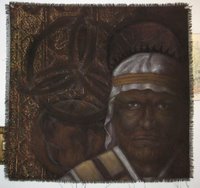 Updated: (click on the picture for a nice large version with reasonable detail) I have finished the painting for the most part, so I cut the fabric down and took this pic. Now I just have to wait a few days for it to dry so I can work on stitching. Not entirely sure what I will do, I am afraid I'll wreck it! I am also abit wary of the gold leaf I intend to apply-I've never worked with it before, and I imagine fabric to be a less than easy ground for it.
I think I will be conservative in embellishment-much more so than I had originally planned. I do hope to give it more definition, as I can't do much more with the paint. This is also about how dark the piece actually is-the fabric continually darkened for weeks after that iron bath!
I have been awake for 25 hours. I woke up far too early and finally transferred the design for Athanasius onto the silk. After coming home from work, I went right back to it. I smell like oil paint, a good feeling. At the moment the piece is too low contrast (the strength of my method is it's subtlety) I don't want it quite that subtle however. I have lightened all of these photos for better readability.
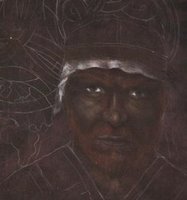 This is the first rendering of the face-I particularly liked the way it looked-less smirky than the drawing. However it was so dark it was almost unreadable in the photo. More layers of light had to be added. It doesn't look as well now though.
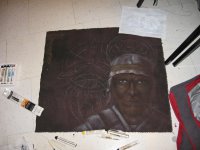 This one is the top laying on the floor as I was working it, paintstiks, brushes and my coat surround it. Yes I got home, took my coat off and worked at it! This is also the first time I have used sticks rather than tube oil paint (They were the thing that took months to arrive!). I like the dryness of them as they go onto my brush much more lightly, reducing the need to brush as much off.
I continually took photos to get an appreciation for how it was reading.
 This is how it looks right now. He looks a bit more cranky in this picture (less so in life), perhaps he is thinking of the Eusebii (I don't know if that is actually a word...). the coptic textile design has been rendered in gold to the left. the first attempt gave me a much more readable design, but oh well.
There is still much work to do, but I feel better to have finally started work on the actual piece after all these months of stalling. I designed this just before my practicum-almost a year ago! I kind of wish I could leave it dark and low contrast; it looks very cool that way, dark and moody.
 Updated: (click on the picture for a nice large version with reasonable detail) I have finished the painting for the most part, so I cut the fabric down and took this pic. Now I just have to wait a few days for it to dry so I can work on stitching. Not entirely sure what I will do, I am afraid I'll wreck it! I am also abit wary of the gold leaf I intend to apply-I've never worked with it before, and I imagine fabric to be a less than easy ground for it.
I think I will be conservative in embellishment-much more so than I had originally planned. I do hope to give it more definition, as I can't do much more with the paint. This is also about how dark the piece actually is-the fabric continually darkened for weeks after that iron bath!
I have been awake for 25 hours. I woke up far too early and finally transferred the design for Athanasius onto the silk. After coming home from work, I went right back to it. I smell like oil paint, a good feeling. At the moment the piece is too low contrast (the strength of my method is it's subtlety) I don't want it quite that subtle however. I have lightened all of these photos for better readability.
 This is the first rendering of the face-I particularly liked the way it looked-less smirky than the drawing. However it was so dark it was almost unreadable in the photo. More layers of light had to be added. It doesn't look as well now though.
 This one is the top laying on the floor as I was working it, paintstiks, brushes and my coat surround it. Yes I got home, took my coat off and worked at it! This is also the first time I have used sticks rather than tube oil paint (They were the thing that took months to arrive!). I like the dryness of them as they go onto my brush much more lightly, reducing the need to brush as much off.
I continually took photos to get an appreciation for how it was reading.
 This is how it looks right now. He looks a bit more cranky in this picture (less so in life), perhaps he is thinking of the Eusebii (I don't know if that is actually a word...). the coptic textile design has been rendered in gold to the left. the first attempt gave me a much more readable design, but oh well.
There is still much work to do, but I feel better to have finally started work on the actual piece after all these months of stalling. I designed this just before my practicum-almost a year ago! I kind of wish I could leave it dark and low contrast; it looks very cool that way, dark and moody.
Tuesday, 12 September 2006
You think to escape, but it can not be
Earlier parts of the saga are here. :)
Once Alexander was gone, his authority (and therefore the battle against Arius) would fall to his protege Athanasius. I am sure he had no warning of how much trouble the Arians would be. Then again, I am also sure they were completely unaware that one little man could create such colossal havoc for their evil cause.
Though the Son knew-from eternity past of course.
I FINALLY got a reasonable colour on the noil for Athanasius.
I initially used synthetic dye with acid and it went frickin purple! (I think the shelf life on those particular dyes is about over) a quick tea dye browned it a bit. Then I worked on it with an entire bottle of silk dye-and ran out of that. Last attempt was multiple extractions from walnuts and tea bags (no less than 7) allowed to reduce down into concentrated stock, a long hot soak and finally a post-mordant of iron to react with the tannin (decided against chrome when I changed the layout). It is still a dark medium brown-I would have liked it darker and I may do a second dip with the tannin/iron if I feel so moved. But I don't think I am going to be able to get a really dark shade on that particular fabric. Much of the first dyebath rinsed out.
Athanasius has proven as troublesome to me as he was to Arian heretics. I have been trying to print out the pattern and used a good 50 pieces of paper before I got something approaching the correct size (stupid printer! When I type 20 inches into the size box that means it should print to that size!!) >:(
It also took one heck of a lot of pondering (granted I was listening to apologetics.com on the computer at the time) to come up with a solution to creating a raised form of the coptic textile I am using for the background. I was thinking of carving, molding, lying-the final winner was to syringe it on to paper using gesso. I was surprised that it worked (especially given the heaviness of the silk), though I will have to be careful with the rubbing as the design is only slightly raised.
I am almost afraid to begin work on the actual piece! Perhaps I've already run my stream of crappy luck with this one. What else is going to happen?!
Wednesday, 23 August 2006
Dyeing
I haven't dyed much in months, so I decided to get some of the pots out and work on some of my bag of mohair. I wanted some muted green/blues. They turned out reasonably well, I especially like the blue.
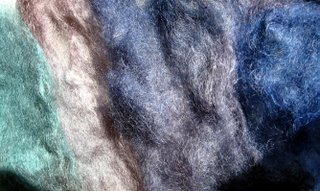
The pinkish stuff is more a silvery grey in life, and the green is a bit deeper. Now I must do something with it!
The silk for Athanasius is proving to be difficult to obtain the correct colour on. I want a dark muted brown (almost black)-not a chocolatey brown though. That is the challenge. Perhaps I'll try black walnut-of course then I'll have to hunt some down, as there are none here. I've never used black walnut before, but it should be a straight forward cooking pot method, which is easy.
I am beginning to feel like I will require the perseverance of Athanasius to get it finished, heheh.
I've got too many projects going at once. Since I also work sporadically now, My general way of doing things, ie whenever the heck I feel like doing it, has been interupted. Gotta get used to that. Well I tell myself I must do something to get the money to buy dye stuff. :)
ETA: I spun up a little bit (one combing's worth) of the mohair with that brown alpaca I am so fond of-it is a rather pleasant muted teal overall.
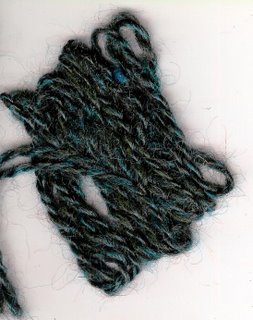

The pinkish stuff is more a silvery grey in life, and the green is a bit deeper. Now I must do something with it!
The silk for Athanasius is proving to be difficult to obtain the correct colour on. I want a dark muted brown (almost black)-not a chocolatey brown though. That is the challenge. Perhaps I'll try black walnut-of course then I'll have to hunt some down, as there are none here. I've never used black walnut before, but it should be a straight forward cooking pot method, which is easy.
I am beginning to feel like I will require the perseverance of Athanasius to get it finished, heheh.
I've got too many projects going at once. Since I also work sporadically now, My general way of doing things, ie whenever the heck I feel like doing it, has been interupted. Gotta get used to that. Well I tell myself I must do something to get the money to buy dye stuff. :)
ETA: I spun up a little bit (one combing's worth) of the mohair with that brown alpaca I am so fond of-it is a rather pleasant muted teal overall.

Thursday, 11 May 2006
Athanasius out of exile...for awhile
I haven't had so much to post (as usual) as I am spending too much time lurking at other people's blogs, and not doing anything constructive. I did make a dress last night, first thing I've actually done in a while.
Soon all of my supplies for Athanasius will be here, and I can get to work on that. I bought some lovely silk noil (raw silk) for him-It is nice and heavy, and not as slubby as is normal. I am hoping the paintstiks will work overtop of it.
As I have often said, all the deadliest poisons make the greatest art supplies. To that end, I must get out the evil poisonous chrome so I can mordant and dye the underpiece. Yes I am one of those pernicious miscreants who uses chrome! That level of depravity does indeed exist. A walking testimony against Pelagius, that's what dyers who use chrome are.
Anyway, I don't think I ever posted it, but this was the compromise I came to in the design:
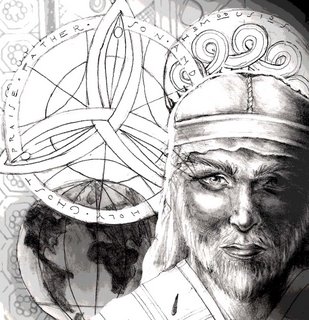
The flow is a bit improved, which I needed to bring the eye back to the trefoil. Plus, I still will be able to have my crop (well after a fashion). The earth will likely not be that dark; photoshop rendered it darker than I liked as it recedes a little too much. The background should also be darker if all goes well and the chrome does not kill me-this time. I already know that is how I will die-it's just a question of when and whether I'll get the latest art project done before it happens.
I don't like the way his face turned out in this rendition and will try to go closer to the original rendering when I do it. I've never used paintstiks before, only unarchival oil paint-I do hope the application goes well on that slubby texture!
I fear I may have gotten a tad ambitious with the idea, so we'll have to see how it decides to turn out.
Soon all of my supplies for Athanasius will be here, and I can get to work on that. I bought some lovely silk noil (raw silk) for him-It is nice and heavy, and not as slubby as is normal. I am hoping the paintstiks will work overtop of it.
As I have often said, all the deadliest poisons make the greatest art supplies. To that end, I must get out the evil poisonous chrome so I can mordant and dye the underpiece. Yes I am one of those pernicious miscreants who uses chrome! That level of depravity does indeed exist. A walking testimony against Pelagius, that's what dyers who use chrome are.
Anyway, I don't think I ever posted it, but this was the compromise I came to in the design:

The flow is a bit improved, which I needed to bring the eye back to the trefoil. Plus, I still will be able to have my crop (well after a fashion). The earth will likely not be that dark; photoshop rendered it darker than I liked as it recedes a little too much. The background should also be darker if all goes well and the chrome does not kill me-this time. I already know that is how I will die-it's just a question of when and whether I'll get the latest art project done before it happens.
I don't like the way his face turned out in this rendition and will try to go closer to the original rendering when I do it. I've never used paintstiks before, only unarchival oil paint-I do hope the application goes well on that slubby texture!
I fear I may have gotten a tad ambitious with the idea, so we'll have to see how it decides to turn out.
Thursday, 9 February 2006
Athanasius Contra Mundum
Anyone who knows me is aware that when the new heavens and earth have come, and I am in the City of God, I am going to make a journey to find two people. The first is Jeremiah; I feel so kindred with him. The second, Athanasius, is just one of my absolute heros.
I decided to make a piece of Athanasius on a bit of a whim, and I thought I might document a piece from the beginning to end here. So yeah I'm still in the sketch stage with this one, working out a conundrum already.
The original idea that came to me was of his face severely cropped in half, with three interlocked circles behind him. I know that is technically bad composition, so I drew the entire face. Everyone who has looked at it so far (that being mama and dad) has liked the full face version; I still want it cropped. Once I decide what I will do, then I can start working on the full version of it.
All two of you who may occasionally view the blog may weigh in if you like; which version is more pleasing to you?
Here is the full sketch (yes the left eye is wonky because I figured since it wasn't going to be in the finished piece, I could be lazy with it) :

This is how it would look cropped like I want (with some things moved to fit):

I *really* want to work a coptic style textile into the background. I am thinking I'll work a fair amount of metallics into it as well, and I just know I will swear alot at it for insisting it must have them.
I decided to make a piece of Athanasius on a bit of a whim, and I thought I might document a piece from the beginning to end here. So yeah I'm still in the sketch stage with this one, working out a conundrum already.
The original idea that came to me was of his face severely cropped in half, with three interlocked circles behind him. I know that is technically bad composition, so I drew the entire face. Everyone who has looked at it so far (that being mama and dad) has liked the full face version; I still want it cropped. Once I decide what I will do, then I can start working on the full version of it.
All two of you who may occasionally view the blog may weigh in if you like; which version is more pleasing to you?
Here is the full sketch (yes the left eye is wonky because I figured since it wasn't going to be in the finished piece, I could be lazy with it) :
This is how it would look cropped like I want (with some things moved to fit):
I *really* want to work a coptic style textile into the background. I am thinking I'll work a fair amount of metallics into it as well, and I just know I will swear alot at it for insisting it must have them.
Friday, 14 October 2005
From Athanasius; the bishop of Alexandria, Father of orthodoxy, and my favorite church father:
I admit it, I bawled like a little gel the first time I read this. I think Athanasius is the only person who could draw that kind of emotion with sheer polemics (usually polemics stir rather different feelings in people, heh).
Though it is not the main point of his argument, Athanasius' acknowledgement of
1)death as a powerful enemy and,
2)Christ as the Archvictor over death which then is something we who follow him can scorn,
is such a different tack then the one often taken in the church today. It is a far superior tack if you ask me. No "christians are happy about death because it is a release from the world of woe and we are glad to be going home". Rather Athanasius builds his argument assuming everyone realizes what a horrible enemy death is. When death does come, it does not feel like something natural or good-because it is not. Our hope is not the "release" of death, but rather that we belong the one who forced death to release him from it's bonds. And he will carry those who cling to his cross back with him.
After masses of hollow platitudes about death that seem to cover the painful wounds only slightly, Athanasius comforts with a much better balm.
Future generations: When I die, do read this exerpt at my funeral. If you say I have "gone home" or "left the mortal coil" I will make a point of coming back to the mortal coil to haunt you.
If... it is by the sign of the cross and by faith in Christ That death is trampled underfoot, it is clear that it is Christ Himself and none other Who is the Archvictor over death and has robbed it of its power.
Death used to be strong and terrible, but now, since the sojourn of the Savior and the death and resurrection of His body, it is despised; and obviously it is by the very Christ Who mounted on the cross that it has been destroyed and vanquished finally.
When the sun rises after the night and the whole world is lit Up by it, nobody doubts that it is the sun which has thus shed its light everywhere and driven away the dark. Equally clear is it, since this utter scorning and trampling down of death has ensued upon the Savior's manifestation in the body and His death on the cross, that it is He Himself Who brought death to nought and daily raises monuments to His victory in His own disciples. How can you think otherwise, when you see men naturally weak hastening to death, unafraid at the prospect of corruption, fearless of the descent into Hades, even indeed with eager soul provoking it, not shrinking from tortures, but preferring thus to rush on death for Christ's sake, rather than to remain in this present life?
If you see with your own eyes men and women and children, even, Thus welcoming death for the sake of Christ's religion, how can you be so utterly silly and incredulous and maimed in your mind as not to realize that Christ, to Whom these all bear witness, Himself gives the victory to each, making death completely powerless for those who hold His faith and bear the sign of the cross? No one in his senses doubts that a snake is dead when he sees it trampled underfoot, especially when he knows how savage it used to be; nor, if he sees boys making fun of a lion, does he doubt that the brute is either dead or completely bereft of strength. These things can be seen with our own eyes, and it is the same with the conquest of death.
Doubt no longer, then, when you see death mocked and scorned by those who believe in Christ, that by Christ death was destroyed, and the corruption that goes with it resolved and brought to end.
I admit it, I bawled like a little gel the first time I read this. I think Athanasius is the only person who could draw that kind of emotion with sheer polemics (usually polemics stir rather different feelings in people, heh).
Though it is not the main point of his argument, Athanasius' acknowledgement of
1)death as a powerful enemy and,
2)Christ as the Archvictor over death which then is something we who follow him can scorn,
is such a different tack then the one often taken in the church today. It is a far superior tack if you ask me. No "christians are happy about death because it is a release from the world of woe and we are glad to be going home". Rather Athanasius builds his argument assuming everyone realizes what a horrible enemy death is. When death does come, it does not feel like something natural or good-because it is not. Our hope is not the "release" of death, but rather that we belong the one who forced death to release him from it's bonds. And he will carry those who cling to his cross back with him.
After masses of hollow platitudes about death that seem to cover the painful wounds only slightly, Athanasius comforts with a much better balm.
Future generations: When I die, do read this exerpt at my funeral. If you say I have "gone home" or "left the mortal coil" I will make a point of coming back to the mortal coil to haunt you.
Subscribe to:
Posts (Atom)