Showing posts with label fibre art. Show all posts

Sunday, 22 February 2015

Making Extracts and Messes

 I made this post earlier, but it's been languishing in the draft file. So I might as well post it before it gets to the point where it's been too long, like most of my unposted drafts.

While Shemar hasn't been working, I've been doing other things, most especially with my Christmas present, and trying to figure out how to make the mukluks but too scared to actually cut the material. My first project with the new burner has been a bit of a comedy of errors. Like most of my dyeing experiments.

After the last disaster mama said "you are always trying so hard on these projects and they always backfire on you". Which is true and why I'd never be able to do anything creative professionally. Accidents are really the primary part of my creative process.

I've had some cochineal for years and never used it. Since I know it can produce a lot of dye by multiple extractions, I decided I wanted to make a powder extract. I looked on the Place For All Answers, the natural dye list, but couldn't find anything much on the best process to produce a powder extract. So I thought well it would just be about extracting and then dehydrating, can't be that hard. But then I forgot this was being done by me.

The process took up most of January but I did manage to produce 30g of dye extract which should dye 300g of fabric. It's also the amount of bug I started with, so I have an extract that should be ten times more potent than the whole bug. So it's not entirely unsuccessful.

Through the errors I've figured out the best way to do this is to make small batches of dye and then bake it in a pyrex plate at about 300F and scrape out with a razor. But it took a lot of not doing that to get to that point. My basement looks like I killed someone in it, and so did my hands. Red EVERYWHERE. But got to do some cool experiments anyway. And I took pictures for mem's benefit, since he is so interested in dye process (hah). I intended to post them here but I'm lazy so it's taken me the better part of a month.
The bugs secreting their lovely red. I ground them up a little, but not overly so. Once they had been reconstituted, they really did look like bugs again. 

  first extractions, so red they were opaque. I'm pretty sure I did at least 20 extractions before the bugs stopped producing enough colour to be worth it.

At this point I decided to siphon off some of it in case I ruined it and see what I could get for colour. The first attempt precipitated, and now I have some cochineal pigment after I cooked it down. Then I got some nice pinky reds on silk and alpaca. The silk surprisingly took the best colour. This is the same silk I used for Athanasius and John Owen, and it never took ANYTHING well. Except cochineal apparently. 
As I continued to extract, I put the small extractions into my giant stock pot with a light to reduce and the plan to cook that down in the pot. But I started to notice some black sludge forming at the top. Didn't know what it was or why it was there. Was it going bad? I skimmed it off with shop towels.
 
black crap. 

When I dyed the yarn, I added a little vinegar to shift the colour a bit. The black sludge turned bright orange. Turns out it was dye material and I had gotten rid of it (I had reserved about a cup of it because I wondered if there was something I could do with it and there was soo much. So I only threw away some of it, but it all had to be reconsituted). Here it is on the table where I had spilled some of the black--orange in the vinegar. 
Damn it I threw away dye. I pulled out the shop towels and soaked them in vinegar to pull the dye back out. I'm not sure what kind of chemical thing was going on here, only vinegar would return it to a coloured dye material from a pure black.

   reconstituting the sludge.

 Making a mess. I looked like I slapped someone silly after this. Prolly what Nicholas of Myra looked like after the council of Nicea.


This is the sludge that was sitting at the bottom of the big stock pot when I strained it. I decided to pull that out and start drying it out on its own. 


I put the sludge on some foil and stuck it in my pyrex plate. I cooked it on broil and it worked nicely. The second time I put it on broil without foil, the plate broke when I pulled it out. So I need a new plate. Then I broke another one! Mama told me to put it on bake instead of broil and the rest of the extractions went nicely. But more dye wasted. :( 

Originally I attempted a dehydration set up with a light and aluminum foil. This actually worked pretty well, except the plastic melted and the containers were too small so it took longer for the stuff to dry out and turned out to be difficult to scrape out. I eventually started just pouring each extraction into the pyrex plate and cooked for like half an hour then scraped it out. I'd get about a gram of dye with each extraction. 

Altering the colour of the saved bit. Ammonia added to vinegar. 

After I realized that the black sludge was in fact dye and pulled out what I could from the shop towels soaked in vinegar as well as the cup I reserved, I played with the ph a little. 

This is how you get orange and scarlet with cochineal, it's an indicator dye. That is, the colour can be shifted by changing the ph and by adding different auxiliaries.  The ph on the left is about 4 with vinegar and 8 on the left with ammonia.


The final result. 30g of carmine (I got some more after this). And probably another 30g all over my basement. Some of it did wash out of my housecoat. Some of it.

I'd like to try this with my wood dyes, but they're way more temperature sensitive in my experience, especially logwood. My first logwood experiments became a very ugly brown that actually seemed to discharge the purple colour before it ever even got to the boiling point. That was an interesting, if less than cool experiment. So I guess I'd have to cook at much much lower temps. And probably dehydrate in an actual dehydrator because baking would probably destroy it.

So I have pure forms of two of the dyes for project. Murex next, right?

Sunday, 11 January 2015

Odds and Ends (last one)

So I personally think an art project based on the colours and white would be just about the coolest thing EVAR. Plus I could write a major best selling book documenting the process, which would also be my dissertation in being a not-pastor.  Then I could stop battleaxing and just retire to a life of self-agrandizement, which is basically what artists have to do to get noticed these days. Unfortunately the thing keeping me from it is that a murex vat would cost about 60 grand to make. Major sad.

Anyway I asked mem if I should put historic references into the post because the arguments rely on history a lot. I hate putting references into a text because they distract from the thought flow, but I did write it so that most of it could be referenced pretty easily if I had to. So these are some of the sources I used (referencing process is harder since I don't know how I know things I learned 15-17 years ago anymore). Rey asked for the references so I'm finally getting this post out.

The cool thing about the subject is that it intersects with many nerdly pursuits: theology, biblical studies, chemistry, ancient history, textiles, archaeology, zoology and so on. Which in my opinion makes it super cool and awesome, but I know from the way most people's eyes glaze over that they don't always agree. If you're not one of the normal people, here is a bit of a list to make it easier for my fellow nerdlings to research. Consider this my bibliography :).

PS I don't even know which citation style to use because there are a lot of different disciplines. And I hate that crap, having gotten a 37% in apa (mla was better). So I'm adding by author, year, article, book or journal, (publisher) for the most part. Or if Rey complains, I'll just edit and make them links.


Barber, E.W. 1995. Women's work: The first 20,000 years. Women, cloth, and society in early times (W W Norton).
This book is easy to read and discusses the development of textile processes from the most ancient times to about 500 bc.

Cardon, D. 2007. Natural dyes (Archetype books). 
This is THE BIBLE of natural dyes. Waaaannnttt 


Guckelsberger, M. 2013. Purple murex dye in antiquity. I can't understand the citation cause it's all something not English and I'm a barbarian :( It's on academia.edu. This one has a lot of the ancient sources mentioning dyes, Including Pliny the Elder. 

Whiston, W (translator). 2009.  The Wars of the Jews or History of the Destruction of Jerusalem of Flavius Josephus (Project Gutenberg). 
He discusses the colours as symbolic of the universe in Book V chapter 5, section 4.

Koren, Z.C. 2005. The First Optimal All-Murex All-Natural Purple Dyeing in the Eastern Mediterranean in a Millennium and a Half, Dyes in History and Archaeology 20, pp. 136– 149 (Archetype Publications).
 A lot of Koren's research can be found at https://edelsteincenter.wordpress.com. Definitely some cool stuff there. He seems to have done a lot of work advancing Isaac Herzog's contention that tekhelet is molluscan. Also he properly reduced the freakin murex vat unlike some others. That makes him WAY more credible.

Additionally on tekhelet there is the P'til Tekhelet foundation at http://tekhelet.com (This where I got the picture of the blue murex dyed fragment and references to the Babylonian Talmud).

Orna, M. V. 2013 Chemical history of colour (Springer). 
This book discusses all the early pigments and dyes, as well as how we see colour and produce dyes. Also a discussion on the rise of the modern dye industry and its relation to medicine and industry. 

Ruscillo, D. 2002. Reconstructing Murex Royal Purple and Biblical Blue in the Aegean, Archaeomalacology: Molluscs in former environments of human behaviour pp 99-106 (Oxbow Books).
More on producing purple and blue. The repeated discussion of the stank made me lawl. Mem would probably relate this to whenever he is talking about Rey.

Also, besides the murex blue, I got the picture of the murex robe from this site.

I've had the picture of the kermes-dyed mantle for a long time because Alexander McQueen used it in one of his designs as part of his final show, and as you all know I'm waiting for God to miraculously make me that good at sewing so I can copy it. So I'm not sure where I got that particular picture from but it is a pretty famous textile.

I also used bible gateway and the blue letter bible for the references, concordance and words. Usually for things like this I look at the NASB. Heavy on the end of Exodus, also Isaiah 1 and 4 and Ezekiel 44.

One of the things I left out entirely was the contrast between clothing and nakedness in scripture. There is a link, especially in Hosea and Ezekiel, but it just didn't fit and probably would have been another thousand words long. But it is a fun study of its own. 

Sunday, 28 December 2014

Light and the Absence of Colour (Part Four)

Colour theory differs in some very significant ways if one comes at it from a scientific or an artistic perspective. While white is the union all colours of light in scientific understanding, to an artist or craftsperson’s mind, colour must be removed to produce white. This interplay of colour and whiteness is utilized by the laws of the tabernacle. The previous posts discussed the sacred colours; this last post is about white and the priestly garments. But I find it requires some background information to get us there.

The Torah includes a number of laws that seem pointless to modern people. One of these is the prohibition against linsey-woolsey or “shatnez” (the prohibition isn’t against any type of blended fibre either; it's very specific that the prohibited shatnez is a blend of linen and wool). Modern people have difficulty explaining or understanding it; they’ll often point to it as an example of a law that is simply meant to differentiate the Israelites from their neighbours (it isn’t). What they usually miss is that the priest was commanded to wear linsey-woolsey, except on Yom Kippur. I guess that’s where dye history and knowledge come in.

 One of the dividing lines between Egyptians and the various Canaanite peoples of the Levant was their use of fibre; the Egyptians detested sheep and everything that came into contact with them, including shepherds and of course wool. They became the preeminent linen producers of the ancient world (it’s through linen production that we can date a likely time for the Exodus). So a prohibition of mixing linen and wool could be seen as a prohibition against syncretism in the vein of the laws against getting horses from Egypt, but it’s likely more than that.

The Egyptians note the brightly coloured clothing of the Canaanites (see the beni hasan murals depicting Canaanites or Hyksos in patterned clothing). Like Joseph’s coat, this was a distinguishing feature of the people of Palestine. It is of course because they favoured the very fibre the Egyptians detested: wool. Anyone who does natural dyeing knows that wool takes almost all colours the best (with the exception of indigo--one would assume murex being a vat dye would have similar properties). Cellulose fibres need a lot of extra processing to take most colour, and it is never as bright. So while linen was sometimes dyed, it was usually bleached. When you wanted true vibrant colour you opted for wool (see our samples from my dye trip post and how wool takes dyes compared to other fibres). Vat dyes would produce good colours on cellulose fibres, but other dyes need some chemical wizardry (in some cases, a 29 step process). The material isn't mentioned in Exodus, but since shani was not a vat dye, wool would be required to get a bright scarlet. This is later confirmed by the author of Hebrews. The coloured threads were made of wool.

Which brings us to the clothing of the priest. The garments he was to wear included an ephod and sash woven or embroidered in a pattern with both the sacred colours and linen. Meaning those items were made of linen and wool blend, as were much of the tabernacle textiles. Consider that the coloured yarn is mentioned in addition to linen. There are sometimes a lot of gymnastics done in rabbinical writings about what counts as shatnez and what doesn’t, but only a few dispute that the priestly garments and tabernacle were shatnez. Some Jews also believe the prayer shawls laymen wear were to be shatnez as well.

In other words, like the special incense, this blend was to be set aside for sacred purposes. So it wasn’t about making the Israelites peculiar. The tabernacle and the priest were being singled out from the people, the holy from the common. Mem says this is like how no one was to work on the sabbath but the priest. Just as we now do not work, and instead trust that our Lord is “always working” for us.

 A second part of the equation is that on the day of atonement, the high priest wore linen only. This not only prevented sweat (since basically any discharge was a sign of uncleanness) but also did away with the wool embroidery/weaving and colour. Ezekiel re-iterates this and says the new priesthood of his vision does not wear wool but only linen (which again implies that the daily priestly garments at the time were in fact shatnez). That the wool, with the colours of blood, judgement and death is removed when atonement is made is a powerful picture of the true work of the final high priest. shatnez for now, but finally linen pure and clean. A little bit of simil justus et peccator.

 As noted the production of these dyes is very ancient, and at various times, controlled by royalty. This has led some to think the dyes were commanded just because they were valuable, to remind people of the kind of respect God deserved. But God tells David he's not particularly interested in human displays of wealth, and the fact that all traces of the colours were removed from the sacred robes on the day of atonement as well as Ezekiel’s vision suggests that this was all very intentional. If the colours represent the work of God (both for salvation and judgement), perhaps the lack thereof represents the results. It reminds one a little of the blinding visions of God, not to mention Peter’s description of the transfiguration. White and light, all colours blurred into oblivion.

So while there is an element of royalty and status in the colours and, as YHWH himself said, “glory and beauty”, it is interesting that on the day of atonement, the priest appeared with “no beauty or majesty to attract us to him”. He arrived before God in plain white. White like the dress of the angels, and finally the dress of the martyrs, white robes given to them by the lamb and final high priest, bleached in his blood. The restored priesthood with Christ alone as their head don’t wear beautiful colours. They wear white like the high priest, like the cord on the door of the temple when atonement has been made. Like God himself as partakers in his nature.

It turns out all colour does unite to make white.

Saturday, 27 December 2014

Symbolism of the Colours (Part Three)

As I mentioned in the previous post, until the 19th century all dyes were what we now call “natural dyes”--with most of these being produced from plants. Murex snails and carmine producing insects were two of the three known animal dyes (lac also is produced from the secretion of an insect). We have established that these were the most likely sources of the “sacred colours”. That is, of all the dyes out there, the ones chosen were the few animal dyes. Dyes valuable because of not only the fastness, but the work and also the death involved--murex requires the death of thousands of snails in order to produce the smallest amount of dye (at least the way the Tyrians did it).

They are also all produced by unclean animals. Jews and Muslims still tend to avoid carmine food dye as it is cochineal, another carmine producing insect. Though one could argue that one would have to ingest the colours to violate purity laws, there are plenty of examples of people being rendered unclean by simple contact with an unclean person or item. This is part of the reason I’m inclined to believe those Jews who argue tekhelet is murex; it then nests better with the other two colours on the symbolic level (though that is not necessary and really the colour IS indigo).

 I don’t think it’s accidental that animal dyes were chosen, and unclean ones at that. The work of the tabernacle was all about cleansing and death and atonement.

 Josephus mentions the colours when he describes the temple, associating tekhelet with the sky, argaman with the sea, and shani with fire. These do line up with some other things we know about the colours. As mentioned in my previous post each colour tends to be associated with different things, both in scripture and in later cultural practices of the Jews.

IT'S THE TRINITY U GUISE
 A few years ago I wrote a post on abrash and trinitarianism, making the argument that natural dyes proclaim a sort of diversity like the trinity. Mem assures me this is not reaching like Origen for the crack pipe, but I do see a trinitarian structure to the colours used. Not simply by the fact that there are three colours and therefore bam it’s the trinity but in the afore mentioned symbolism.

 As I mentioned previously, tekhelet blue covered most of the holy objects of the tabernacle and is the only colour laypeople were commanded to wear.  Josephus’ comparison to the sky is most likely based on the fact that the original Sanhedrin see God standing on a “pavement of sapphire, clear as the sky”. Ezekiel and Isaiah see the glory of God the same way, enthroned in the crystalline blue of the heavens. Numbers gives the reason for the use of tekhelet tassels--to remind each individual to be holy to God.  This colour is almost always used as a reminder of God and his holiness, often emphasizing his righteousness, “otherness” and power.

The symbolism for shani ranged almost contradictorily from sin to purification. While modern people often suppose that scarlet is associated with blood rites, it’s more often associated with cleansing rites and “fire” in scripture (usually blood was included separately). Fire is actually the primary purifier in the torah, with water being used when fire couldn’t be; but the scarlet wool features in both types of rites. Isaiah, while famously saying that scarlet sins become white, also says that such blood stains are washed away by a spirit of judgement and fire. He also associates the towla or worm with the unquenchable fire of judgement, a picture Christ echos later. It calls to mind that John said Christ would baptize not with water, but with “the Holy Spirit and with fire”. Of course the Holy Spirit manifests as fire in the new testament at pentecost, as God does several times in the OT.

I'd like to wax Calvinist about the fact that the bread of the presence was covered in shani-dyed cloth, but I'll leave that for you people to decide. >:)

While Josephus associates it with the sea due to it’s source in the same, purple almost universally signified royalty. When Christ was mocked he was wrapped in a purple cloth; the soldiers were clearly mocking Christ’s claim to be king of the Jews, the anointed one. But it’s hard to think the connection of Christ being wrapped in purple just as the altar of atonement was wrapped in purple is coincidental. This action, like the prophesy of the high priest, appears to me to be an unwitting acknowledgment of what he was truly doing. Again, of all the tabernacle articles, only the bronze altar was covered in purple. The significance of a bloody altar/Christ is hard to miss. Argaman, and not shani, is the colour of blood and atonement.

With all that said the colours seem to represent the triune nature of God, but perhaps even more the roles of the person of the Godhead in the salvation of man. It wouldn’t be surprising that the colours chosen intended to represent the God who met his people in the tabernacle. Not that I’d push it, but it doesn’t seem that far out. It’s through the workings of the persons of the trinity, in the place where God meets his people, that we are finally made holy, righteous and clean. The workings of the persons in bringing us into communion with God are all there.

As the writer of the epistle of Barnabas notes, in salvation he takes broken human beings and makes them into living stones of an incorruptible temple. In so doing, he makes us “partakers of the divine nature”. With that said, there’s a final piece to this puzzle, known as “shatnez”.

Friday, 26 December 2014

The Colours (Part Two)

The history of dyes is older and full of more intrigue than one might think. Until the 19th century, all textile dyes were produced by and extracted from plants or occasionally animals, with the rarest and most colourfast being the most valuable and sought after. It can sometimes be surprising to modern people how sophisticated the techniques really were--vat dyeing with murex for example appears to go back as far as 1800 bc.

There are numerous colours that were well attested by the time of the Exodus, but a set of three become the centrepiece of the tabernacle. These are the “sacred colours” of Exodus: tekhelet, argaman and shani--translated as blue, purple and scarlet respectively. These three colours decorated all the cloth items in the tabernacle as well as the priest’s garments and were used to colour the cloths that covered the holy items when being moved. Each colour is also used individually in the items or rites of the tabernacle. However they’re not generic colours as we might think in a world of chemical dyes; each was produced from specific sources which gave distinct shades of each colour. For example, while madder red was used at the time, scripture is clear that shani is produced by an insect.

Towla Shani
As mentioned, shani is actually referred to as towla shani or “worm scarlet”. There is no question it’s a bug dye (“worms” including larvae of insects), made from an insect known as kermes. The female kermes insect produces carmine (we get the words “carmine” and “crimson” from kermes, while “vermilion” comes from the latin name for worm--the kermes vermilio) and has been used as a dye since neolithic times. While it usually produces crimson, the dye bath can be altered to get scarlet as well (crimson being blue toned, while scarlet is orangey), though the scripture uses them as parallel synonyms (ie Isaiah). Shani can only be carmine red.  I’ve seen one or two people deny this since “the colour of fire is orange, not red”. But those people are morons; don’t look directly at them.

It’s also important to note (for later) that kermes is the only colour of the three that isn’t a vat dye. It’s what we know as a “mordant dye” because it requires an auxiliary (the mordant) to bind it to the fibre.

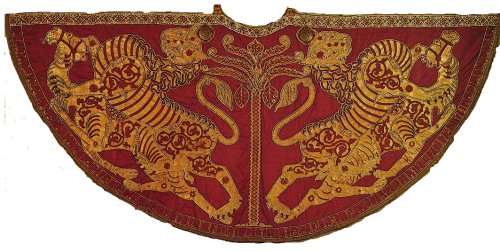
roger_ii_mantle_full.jpg

Kermes (red ground) on silk--the coronation mantle of Roger II of Sicily

Shani was usually used on its own in cleansing rites. Wool dyed with worm scarlet and hyssop were used to sprinkle the blood of the dead bird over the living one to be set free in leper and house cleansings. It was also to be included in the burning of the ashes of the red heifer.

The scarlet yarn also features in later interpretations of the rite of the day of atonement. In a ritual probably based on Isaiah’s prophesy, a scarlet cord was to mark the goat for azazel and after splitting it, half would be tied to the temple door and observed. It was thought it would become white if YHWH had indeed cleansed and forgiven the people. This also harkens back to the cleansing rites using the two birds, one killed and one freed.

Argaman
There is really only one purple of note in the ancient world, produced by molluscs and more commonly known as murex. As mentioned we have examples of murex dyeing as far back as 1800 bc--this is the source that is intended when the word purple is used. The Greeks even called Tyre “Phoenicia”, the land of purple, because of the production of murex. Lydia sold murex cloth, and at times its production was funded and controlled by royalty around the mediterranean (this continued until the end of the Byzantine empire). In Exodus this colour is called argaman.

 So like shani, argaman isn’t just a generic purple, it’s an item dyed in murex. “Tyrian purple” is the most prized form of it, produced from overdying in two breeds of murex according to Pliny the elder. The colour is sometimes known as oxblood, as in the ancient world the most prized shade was that of “clotted blood”. It’s more akin to maroon than a bright purple we may think of.


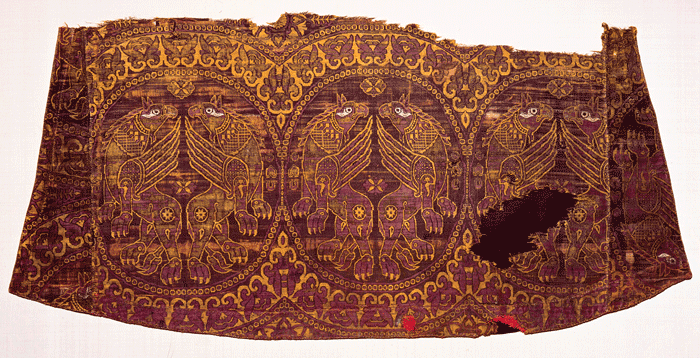
article5_img1L.gif

murex dyed byzantine robe--murex is apparently difficult to photograph. It is also unusual in that it darkened with time rather than faded, and could eventually turn black through oxidation. Thus the colours aren’t the most accurate.

This dye, the colour of blood, is the colour of cloth YHWH commands should cover the bronze altar. It is the only thing that is covered in purple alone--even the ark is covered in blue. There are no other uses for argaman specifically.

Tekhelet
Tekhelet has an interesting provenance, or lack thereof. It’s the only dye of the three whose source isn’t completely agreed upon. The colour is almost certainly indigo blue on the chemical level so we do know basically what colour it was. But there are debates between Jewish writers over whether the indigo is produced by the indigo plant or by murex, and over what shade of blue it was. Talmudic writings do claim this colour was produced by a "fish" (ie shell-fish) and that indigo was a cheaper copy of the real thing. If so, murex is the most likely dye as certain breeds can produce blue with exposure of the vat to UV. The only other known animal dyes all produce shades of red.

The argument for murex is also compelling because there have been murex dyed blue items found in Israel from the time of Bar-Kokhba. So we know they were using it at that time. It seems odd to use murex if indigo could be used, because indigo production is comparatively simpler. That said there appears to be a tradition that the colours had to be "locally sourced". If true this would explain why murex was used for blue.

Tekhelet-dyed cloths covered almost all the items of the tabernacle service when they were on the move, with the exception of the altar covered in argaman as mentioned. The bread of the presence and dishes are also covered with shani-dyed cloth, after being set on the table over a tekhelet cloth. All the loops and tying cords of the tabernacle were also blue. The priest also wore a tunic entirely dyed in blue.

Tekhelet is of particular focus for Orthodox Jews because it is the only colour laymen were commanded to wear on the tassels of their garments (the blue of the flag of modern Israel commemorates the blue tassels of the prayer shawl). For some time the colour has been considered “lost” because of the disagreement over the dye source--again not any shade of blue will do.

ancient-dyed-fabric.jpg

The blue version of murex on wool from around the time of the Bar-Kokhba revolt. These dyes were prized at least partly because of their unmatchable fastness.

Interestingly, the same three colours were also important ritual colours in many other cultures, as far away as the Americas (with different sources--see the traditional Oaxacan wrap skirt for a different configuration of them). This has to do with the beauty and general fastness of the colours as well as the difficulty of producing them; murex alone is historically one of the most expensive and labour intensive dyes to produce. When YHWH demands everything be made with gold we think that made it precious. But murex was equally precious (in the modern age, it’s actually MORE precious. Than fricking GOLD. Yeah). When scripture speaks of people of status and security, blue, scarlet and purple are mentioned. Across the world these colours symbolize wealth and status, or as YHWH himself says, “glory and beauty”. But they also are tied to other things. More on that in the next post.

Thursday, 25 December 2014

Colours, Sacred or Otherwise

Since mem is a wicked human being who won't get his dad to make me dibromoindigo, I'm being forced to think of other ways to get it. This includes making a trip to Morocco to some place I can’t pronounce in the purpuric islands that is rumoured to sell it (and yes a trip to MOROCCO would still be cheaper than buying it from most reputable suppliers by about 40k). It seems legit.


PLUS ALSO Pantone’s colour for 2015 is pretty close to what Tyrian purple would have looked like (though more brown). AND I got an induction burner for Christmas which Phil called WITCHES BREW BURNER. Well it's taken them almost two decades to come to terms with my use of noxious chemicals.

So my art project is back on! In my head. Like usual. This of course brings to mind some interesting things I've noticed in the colours and textile processes used in the production of the priest's garments and tabernacle of Exodus. Mem assures me these things aren’t super extra BORING to normal people, but I’m pretty sure he doesn’t have a lock on what normal people think or he wouldn’t be my friend.

But I’m going to write about them anyway, because mem is the only one who reads my blog and I think he thinks I can’t write a book length tome on this. To which I say “it’s like you don’t even know me mem”.

 I am reminded of the author of Hebrews saying that the tabernacle was a copy made according to a heavenly original. Some people think this has to do with aesthetics; I am not one of them. The tabernacle represents the realities of God; how he makes himself a holy priesthood and a place where he meets his creation. And maybe I’m crazy but I think that’s more significant than the proportions being an aesthetic pattern for people to follow. While many fixate on the proportions and other things, I’ve always been interested in the processes. I can admit that’s the craftsperson coming out--process is always the most important thing to us. But I do think there are some powerful symbols involved in the creation of the tabernacle (symbolism being used in the more mediaeval sense).


Anyway, there are things going on in the text that are pretty easily missed if you don’t understand how the production of fibre worked in ancient times. In a world where we are so removed from the processes that make the daily items of our lives, we miss many things that would have been common knowledge then. I think this can be shown by how Christians tend to interpret them sloppily and figure they’re not particularly important anyway. Orthodox Jews for their part debate them intensely--they understand that they’re valuable at least partly because they’re still trying to keep the law.  But we believe all the scriptures are about Christ.

I originally wrote this post super cyclically (like a rabbi! Just as wise for sure). While that was pretty cool, it metastasized into a 3000 word document in a few days (even though I skipped a lot of cool stuff--told you mem). So I had to make it linear (or as close to it as someone like me can get) in order to be able to chop it up into shorter posts, of which this functions as the introduction. It took longer to reorganize than to write or research, so the work has been languishing a little. But I really wanted to finish at least one of my book length “blog posts” so the reorganization had to be done. Someone asking about the towla on fb motivated me to wax nerdy again. Anyway hoping I succeeded in being more greek, but I really prefer hebrew thought. If you see some repetitions and lack of clarity, blame your western linear mindset--I had to do this for YOU so don't whine. I also left out a lot to keep it from being even longer.

 Follow for the next posts and you'll see why a trip to Morocco would be worth it.

Sunday, 11 May 2014

After Four Years of Exile...

We have finally moved to a place that has room for all my fabric and Fergus (plus at least 20 other cats for Fergus to get beat down by, including a random grey kitten that ran into our apartment today). It also doesn't have the stupidest tenancy agreement of all time, so even though I'm paying more, it's probably all worth it. 

Since I can put shelves on anything that doesn't move and we're paying more for rent, we are getting rid of the storage locker. We have enough room that we don't need it, and while I packed it like tetris before the move, we finally got down to the original layer and brought it all home today. This was virtually all my stuff, including my quilt hoop, the parts of the industrial sewing machine (now in the basement), the homemade drumcarder and fibre, the tubs of dyestuff and pots for dyeing, and the two jumbo tubs of FABRIC.


Ooh tub of TREASURE. SO EXCITING. Those are the poly brocades I hoarded on top. I started pulling everything out of them as soon as possible and depositing it into multiple piles around the living/dining area.


Fabric piles everywhere! And patterns. And test designs. And things I sort of made. And interfacings/fusible web/buckram/timtex. And other wonderful things.


It turned out I had lots of white fabric (mostly silk) for dyeing. Some cotton, linen, organza and also some kind of stiff silk I have no idea what I'm going to do with. It's almost like paper. Definitely silk though, which is my favorite fibre ever:


Especially duppioni, apparently. I love the versatility of silk and the way it dyes. It's the perfect fibre and if silk worms weren't so disgusting and nasty, I would totally raise them to reap the benefits of their hard work and sad little lives. Yay! But they ARE nasty so someone else has to do it for me. I also had some silk hankies (these are pulled out cocoons) in there, which I used in felting projects mostly.

 I took most of the quilting cotton in the form of fat quarters with me and they sat on the shelf of my room, but a few of the larger cuts I put into storage. I found some nice plain blacks and whites, both of which I've bought more of since. Plus some cotton, wool and silk/wool batting. Unfortunately I can't decide which is the wool and which is the silk/wool. Love wool batting though.

Various apparel fabrics plus the sari I bought all cheap. I also had a couple of patterns. I keep trying to do clothing sewing, but I'm just not that good at it. Mainly because I want to be able to sew like Alexander McQueen already and am always sadly disappointed that God didn't just make that happen like when the lame walk and the blind see.  IT'S JUST AS VITAL. Like who wants to make t shirts? I want to make COOL STUFF.

I totally did buy that Japanese Vionnet book in anticipation of him changing his mind on that this time though!!


These are muslins, test blocks and half finished projects. Never have known exactly what to do with some of these. I also have the ties and bits for the crazy quilt I have always been planning. One of these days I'll start it!

 I even found actually finished projects as well (yeah I do have a few of those). This was my big bagua batik. The tiger was probably my favorite, and I dyed the colours with procion mx and sodium alginate. I remember the black being really problematic and it ended up fading quite a bit after I put it in a window, though it was meant to fade out on the edges. Mama was like "let's put it on the table for decoration" haha.

  I also found the logwood dyed things had shifted quite a lot into brown from purple. Gotta watch those browns. And logwood of course. The dye woods are in their own tub, though I suspect I'll have to replace all the noxious chemicals I'm still not supposed to have.


Also,  FYEAH DRAGON


I did not find the three missing quilts. I think they are gone. Mama keeps saying "I didn't take them, just the other ones you found under my bed!!" Sigh.  It's possible they got moved, but they are not in any of the places my other things are. RIP quilts, where ever you are:


:(

Sunday, 22 January 2012

Playing Chicken

Over Christmas I actually got to make a few things. All two of you who are part of the in crowd of theo already know about this, but posting it anyway for posterity:
Heh yeah I just stole the pictures off of Holly's blog. I guess the USian government H8s me now. Oh well, not like I ever played by other people's rules. 

I saw a chicken quilt on pinterest, and decided to make one for Holly since she is a pastoralist now--there has to be some advantage to having little char to care for. Although I'm sure little char can probably care for herself, I'm also pretty sure she's probably totally self-absorbed and narcissistic, which means she is very demanding. And she prolly tries to peck out the eyes of all the happy chickens named after hebrew letters who don't give her books even after they promised to. 

Anyway it's a pretty simple piece, just fused the pieces on and machine embroidered, and quilted in a freeform feather pattern. It's been a long time since I've done any extensive machine embroidery, so I wasn't sure how it would turn out (especially because I had no stablizer), but I used some old bounce sheets and went to it. Here is a shot Holly posted of the embroidery.


 Skillz-I still has em.

Thursday, 20 January 2011

You Wish You Were This Brilliant

In case you were wondering how John is looking (I'm sure you weren't but here he is in all his decorous glory anyway). These things do take time. It never looks right in small versions and this picture does read pretty dark (and grainy), so make sure to click through to the full picture to see it.


Mostly I've been working on the hair. Some of the usual build up of white spaces also. It's always interesting to see how it reads in photos, because you can see problems that aren't obvious when actually in front of the work. Well and I hate the lighting in the crapartment. Along with everything else about it.

I have to settle on some background stuff because I really only have bits of tweaking to do before the local colours. Nothing is really what I want. 

I have to say one thing I do like is that he looks way smarter and more learned than You. Which is of course a reflection of reality.  So that's good.

Sunday, 11 July 2010

Theological Domination

As you all know, I totally think John Owen was an ENTJ. When I am conversing with his books (yes you have to converse with Owen in his books or you'll miss things) I see him ambitious, brilliant and trying to take over the theological world (Richard Baxter notwithstanding). His intuitive powers make him both difficult and fascinating. And now that he's enjoying a renaissance, I imagine he's probably ribbing Richard Baxter in heaven every time someone mentions him as England's greatest theologian, or the greatest Puritan theologian or greatest whatever.

When I decided to make John Owen as brother for Athanasius, I knew that as with Athanasius I had to choose a descriptive mood. Athanasius I had wanted to look indomitable, but I felt John Owen should be vested with a rather imposing sense of gravitas (though in real life he was much more jovial) to match his argumentation. Like a juggernaut, he's not stopping to ask you if you managed to hop on. If you don't get it, it's just going to run you over and crush you into pieces. And that's your problem you silly person.


This is how far I've gotten. He's coming along okay though some more contrast work has to be done. The hook in his nose was ANNOYING as anything. At least I think I've finally got everything where I want it, so it's mostly down to building up the highlights (which of course is the most time consuming part). Hopefully soon I'll be adding local colours and thinking about the background.

I mentioned previously that I liked Greenhill's portrait and mostly used that with imput from others. The eyes in Greenhill's work belie a certain weariness that his drivenness coupled with seeing every one of his children die must have imposed on him. Hoping I did that justice.


Still not sure about what to do with the background yet. I'm going to have to do some homework on that. I've been working a fair bit, but I do have more time now to make stuff. I put up shelves in my room in the apartment so that at least some of my art schtuff can be available-where I'm going to use it is another issue unfortunately.

Also I hate my flash because it's making the colour bleh.


Anyway it's coming along. Athanasius has returned home after his exile at SIAST, so he is currently staring at me and waiting for his brother. I'm working on it!

Friday, 30 October 2009

The Glory of Christ

that real view which we may have of Christ and his glory in this world by faith,--however weak and obscure that knowledge which we may attain of them by divine revelation,—is inexpressibly to be preferred above all other wisdom, understanding, or knowledge whatever...

The revelation made of Christ in the blessed Gospel is far more excellent, more glorious, and more filled with rays of divine wisdom and goodness, than the whole creation and the just comprehension of it, if attainable, can contain or afford. Without the knowledge hereof, the mind of man, however priding itself in other inventions and discoveries, is wrapped up in darkness and confusion.

John Owen, The Glory of Christ, preface to the reader.

As he lay dying, Owen was notified of the pending publication of this work. To this he replied that he had finally arrived at the long awaited day when he would see that glory in a way that he had never seen or could even imagine seeing in this world. He was ready to finally see the glory of Christ, truly as it is, with no glass, no veil. One can't help but think he was ready even as he wrote the words above. Ready to pass from glory to glory, and be transformed.


I am busy with school so I don't have time for much else but I hate the feely paper I have to write for class next week so I am skiving off at the moment. Athanasius is visiting SIAST library for a year (and everyone insists I should declare him finished-he is NOT finished-admittedly he might never be). Some people really gushed over him which was a little embarrassing, and one woman told me she was glad he wasn't white. (Anglicans...) But everyone seemed to recognize his indomitable stare, so that was cool. Hey I conveyed something.

Anyway I started John Owen as a brother for Athanasius over the summer-the noil was as difficult as ever to dye. I did it in logwood, let it soak for weeks, bathed it in iron and back to the logwood. Then I did a wash over it with soliel paint. It's very uneven, but not in a totally bad or unfixable way. That really showed up worse in the picture. I'll fix some of the worst of it later.

This one is a little different just because we know what John Owen basically looked like from contemporary portraits. I am using the John Greenhill portrait of him, which is the most detailed and I think captured his eyes best. I love his eyes in that one. It's also the only portrait including the man's
actual hair. But I'm also using a few others for reference so it won't look just like that one-I think it is a tad idealized after all. I sketched it out and am pleased with the sketch. So far the big piece looks okay-I have to make the hook in his nose more apparent and work on the mouth.

As you can also see, while Athanasius is very low contrast, John Owen will be quite high contrast. The white layers have been rather heavy thus far, so I haven't added as many and I have a good imprint. I found a nice slubby black/grey duppioni that would do well for the background-not too shiny. I should probably buy some. I'm not as sure how I am going to work the background yet. John Owen is hard to pin down, but I am working with his work on communion with God by/and the glory of Christ at the moment-hense the name. I have some shadowy ideas on that, but I haven't come up with anything concrete. So I'll just work on the face for now.

With work and school, I don't have so much time to work on this, but I am thinking I will need at least some distraction some time or feely class will make me tear my hair out. So it's there, waiting. And these portraits require a fair bit of drying time and are easy to just pick up and work on a little here and there, so I think it will be ideal.

Wednesday, 22 October 2008

Regula Fidei

The Church, though dispersed through the whole world, even to the ends of the earth, has received from the apostles and their disciples this faith:
in one God, the Father Almighty, Maker of heaven, and earth, and the sea, and all things that are in them;
and in one Christ Jesus, the Son of God, who became incarnate for our salvation;
and in the Holy Spirit, who proclaimed through the prophets the dispensations of God, and the advents, and the birth from a virgin, and the passion, and the resurrection from the dead, and the ascension into heaven in the flesh of the beloved Christ Jesus, our Lord, and His manifestation from heaven in the glory of the Father “to gather all things in one,” and to raise up anew all flesh of the whole human race, in order that to Christ Jesus, our Lord, and God, and Saviour, and King, according to the will of the invisible Father, “every knee should bow, of things in heaven, and things in earth, and things under the earth, and that every tongue should confess” to Him, and that He should execute just judgment towards all; that He may send “spiritual wickednesses,” and the angels who transgressed and became apostates, together with the ungodly, and unrighteous, and wicked, and profane among men, into everlasting fire; but may, in the exercise of His grace, confer immortality on the righteous, and holy, and those who have kept His commandments, and have persevered in His love, some from the beginning, and others from their repentance, and may surround them with everlasting glory.

Irenaeus, Against Heresies Book I, Ch X

(isn't that sentence on the Holy Spirit just about the longest you've ever seen??)

Warning for Stan: Spoiler-if you like surprises in the mail, don't look any further. If you don't care or you're not Stan, go right ahead.

For those other two of you not in the know I have been working on a piece related to Athanasius for Stan for the last few months. It was designed at roughly the same time, and they were meant to be the beginning of a series.

Anyway because I am horribly lazy and fickle, only the two were ever designed, so I created this one for Stan in blue and copper/browns. It is a picture of Irenaeus, backed by Polycarp and lastly John (which I like to think is the Apostle just because I do and it makes the picture work). So it worked out like this:


The coppery lines across the faces is just the end of a thread I am using to quilt the background.

I still have that same old indigo vat. It freezes solid every year and every year I am surprised that it revives. I ran out of lye so it took an entire container of soda ash and over a week to balance the vat this time around, it was that acidic. But I did it-in fact the indigo gave the best colour I've ever gotten with it. I threw some silks and cottons in also at the time, with varying lovely colours. The colour is stunning and is a wonderful example of my earlier post on the luminosity of Natural dyes. I almost didn't want to paint over it. I darkened it with the tannin from some tea and it mellowed the colour and deepened it for a week or so afterward. This is another wonderful thing about natural dyes-surprises! The photo does not do the colour justice really.

Because the printer was being rather prickish in enlarging the image, I got to learn to make my very own projector from a shoebox, a camera lens, a mirror and a christmas tree light. It sort of worked-kind of. I don't want to do it again.

Here is the pen rendering of the design which was enlarged to become the pattern.

Because of the alkalinity of the vat (okay and because I could not find the noil I had used for Athanasius) I decided to use linen. While it worked out okay and I think that is the reason I got such a good colour, I don't think I'll use linen again. It started to pill as I scrubbed paint on there. The slubs also made an even layer of paint impossible. You can see the slubs and it isn't smooth like the application on Athanasius. It is also smaller, so there is less detail.

Except for those snags the paint went on okay. I am relatively okay with it.

I used the same pattern I had made in gesso for Athanasius to do the rubbing for the background. What can I say, I'm lazy.

I had a hard time deciding how I would add the words to the bottom, so I left it for awhile. Eventually I decided to do a rubbing so I used some old cerne relief paint that I had to pipe out the letters on a piece of paper and then rub over top of them with the copper paintstick. The piece moved when I went to do a second go over at the top, so the letters are not so clear there. I did go back and add some more paint in to render them clearer and some blue ink to make them stand in relief a little more. I actually like the deconstructed ancient look of the letters, even if they are likely quite difficult to read. It is the first part of the above quote that is used. I am thinking I might brown out the letters a little because as copper as they are now they are a little overwhelming.

I found a piece of dupionni that sort of mimicked the copper of indigo blossoms reasonably by being copper shot with blue. I decided to use it for the backing (it is not as orange as it appears in the photo because of the blue warp).

I've still got most of the quilting to do, but I don't foresee many snags there. I put the batting between the linen and the silk, and the edges of the silk are already finished and ready for hanging. Any day I don't have to do a binding is a good one. The linen is a little wonky, but I think it's livable. I'll update when the quilting is done, probably in the next few weeks.


ETA: Here it is with I think the quilting done. As you can see I unfortunately placed it a little crooked, but it hangs okay over all, better than I thought it might given the fact that the centre is so much heavier.

I should quilt the faces to contour them, but I am really wary of doing so. I might and I might not. The colours read truer on the first photo than on this one. Of course the silk is not so orange as it is in either.

Richard looked at it and said "Charlton Heston as John!" Okay so I guess it does kind of look like Charlton Heston. Haha. I hope you don't mind that Stan.

Friday, 3 October 2008

Seeing Colour, Abrash and the Trinity

Some people have asked me about my work in natural dyes. It seems like so much work, they ask, why even bother? Wouldn't it just be easier to just use acid or procion powders, as well as more predictable and safer?

Well yeah actually it would. But though I also work with synthetics, natural dyes have something that the ease of the synthetic can not replace. Some I am sure work in natural dyes because they like to play chemist, but for most of us I think it is because the colour of a natural dye is simply beautiful in a way that can't be mimicked in a synthetic.

I have read many impassioned arguments for the superior beauty of natural colour from it's advocates which is met with confusion and lost on those who don't work in the media. I know enough people who see no difference in the blue of indigo and the indigo blue of a synthetic, yet to me they are clearly not the same colour. So I have begun to think that maybe those who work in natural dyes (or with natural pigments) actually see colour differently than other people. Perhaps we see more colours or distinguish them better?

What we are seeing can be put under the umbrella of what is called abrash (one of many spellings) in the rug trade. All natural dyes, no matter how carefully one may dye them, have abrash-that is variation in hue, chroma and value from dyelot to dyelot or even in the same dyelot. It can be quite noticeable or at times can be very subtle, however it is always present in a naturally dyed item. Even one that at first glance appears to be a single colour always upon closer inspection is comprised of many other colours making it sparkle like facets do for a gemstone.

I think this may be the reason we prefer natural pigment, abrash makes for a richly diverse and luminous colour, a colour that obviously contains other colours. The cold sea of uniformity that is common to the chemically uniform synthetic dye is dreadfully austere and boring. All unity, no diversity. One must take specific steps to try and artificially achieve Abrash-which some actually do (okay okay some is me. I always tinker with the dyes and synthetic dyes gone bad are some of my favorites...) but it is never as beautiful. However this isn't as plain to everyone as it is to those of us who love it.

One might say natural media reflects the trinity, heh. Of course it shouldn't surprise that creations do reflect their creator. A synthetic dye is so singular and homogenous like the men that developed it. A natural dye experiences a little bit of perichoresis of it's own. And of course even though it is beautiful in it's complexity, it isn't always apparent or appreciated by those who don't want to see it.

Everything can be related to theology some way or another.

Monday, 19 May 2008

It's That Season

It's May long and not bad outside. This means one thing.


(silk in alum on the left, logwood being extracted and reduced a little on the right)

That's right: dyeing accidents experiments!!


I was so happy to have found the big canning pots this spring after having lost them two years ago by putting them somewhere "safe" to winter. I thought I could extract my logwood in a little pot and transfer each extraction to the large pot. Happiness dissipated when I discovered the one had a hole rusted right through. And I always find these things out the hard way, like coming out to wonder hey why is there dark liquid leeching out from underneath the pot...?

Look at that hole. Damn. Now I have to find some new ones.


And now I also have a nice purple ring on the step. Glorious dye-wasted!>:(


I told mama "dyeing accidents!" She said "wood makes that colour?" Such things no longer phase her. Then again the porch always was a catch all for messy projects and I think the wood has been every colour it could be. One time an entire 5 gallon pail of blue fibre reactive dye spilled on the floor. I can't remember how that one happened...I think it was the dog. Well whatever it makes the place more interesting, and we have another story to tell to go along with the others. At least it isn't india ink.

Logwood is an indicator though and I'm tempted to throw some ammonia and/or vinegar on the step. Just to see. ETA: so I did. The vinegar made it fade to yellow. The ammonia darkened the purple and ate what paint was left on the step. Heh.

Sunday, 17 February 2008

I Love This Stuff

I've coveted a needle felting machine since the Embellisher hit the market however many years ago, so many things you could do with one! People were always making cool things with them. This week the quilt store I frequent had the Pfaff version on sale. Though it only had five needles (some like the Embellisher itself have seven) I liked that you could change individual needles, and it was a little less chere than they usually are so I bought one.

I have been playing with it all day and I want to go back and play some more. I've done a landscape, a flower, some abstractions, whatever I can think of. I have already broken oh five or so of the needles in my playing, perhaps I am a little too, uh, enthusiastic. I am learning. I haven't gotten to any fancy techniques yet, but I have enjoyed working with it. Oh yeah this is why I used to love to do this stuff-it's wicked fun. I had totally forgotten that little detail.

Now I wonder what I will do with the experiments. Anyone want a needle felted postcard?
ETA: Here they are ready to go. Yay I found a use for the beautiful sari silk yarn I bought awhile back. Now I have to go buy more needles. I have discovered the problem with the needles is that the presser foot is not stopping the machine as soon as I lift my foot. In fact it is sticking pretty good sometimes. I'll have to see what I can do about it.

Tuesday, 12 February 2008

The Golden Decade

Constantine's sons favoured opposite sides in the controversy. The first return was brief for Constantius again deposed Athanasius and after hiding out in the city for awhile he escaped to Rome. In the intervening years the Arians held counsels and wrote their own creeds while the Nicenes countered, many of whom had ended up in exile in the West under the protection of Constans and the Bishop Julius.
At the end of his second exile, Athanasius had been from his people for about seven years and now the Arian bishop who had replaced him was dead. In those years Eusebius also died. Constantius finally offered to reinstate him and Athanasius returned to his beloved flock In Alexandria. The Golden Decade had begun.


Aren't you glad we're to the part of the story where we get rid of Eusebius? Happy turning point there. Ding dong and all that.

It hasn't been seven years but this piece has languished some-though I have regularly been building highlights on it. Particularly given how the test piece worked out, I was afraid of embroidering it as I had originally planned. I still think that would have looked awesome, but I love the piece too much to take many risks with it at this point. I mean I'm sure we can all agree that the test piece looked pretty awful.

Anyway I think that Athanasius would not be impressed to know that fear of ruination would keep me from moving forward, so I decided to abandon the original idea for the embroidery and did running stitches by hand instead. these will be built up in the quilting which I have decided will also be done by hand. The contrast and texture I had intended is simply not there and while I think this does hurt the piece, I can live with this as opposed to an unmitigated disaster of threads.

Perhaps I will expand that coptic theme until I am better at it-companion pieces! Anyway here is how the piece stands. The dupioni has been added and stitches done for the moment.


Because I had chosen to make the halo and the world basically the same size, this meant an unusually small halo, and it is set oddly in the picture because of the shading. That was the thing I played with again and again in the original layout.

I was leary of my original idea of applying gold leaf in a deconstructed manner, but decided to go ahead with it. Now I am regretting that a little...Here is a close-up of the way the halo turned out. I think I can still do some salvaging once paint has dried. I still need to apply the 96th layer of paint to even the intensity out, and some other things.


As mentioned, varying intensities in the paint at the moment are leaving it looking a little wonky, and I have a good amount of work to do on that halo to fix it. But once I decide whether I want to do the edge treatment I had considered then forgotten about then found again, ( I like it but am again leaning against it) I can move on to quilting. Then it's only a few more exiles until finishing.